FP Summer 2024
- “Education in Action”
by Danielle Ivanov / Photos by Nate Guidry. - “A Living Library”
by Cody Hawley / Photos by Scott Wiseman - “An Amazing Visionary”
by Cody Hawley and Styliana Resvanis
The Summer 2024 issue of Florida Physician magazine was my second as art director, and the first to employ the redesigned grids and typography system I created. This meant improved brand alignment and better cohesion between the feature stories, while also allowing more freedom to work creatively in support of the stories.
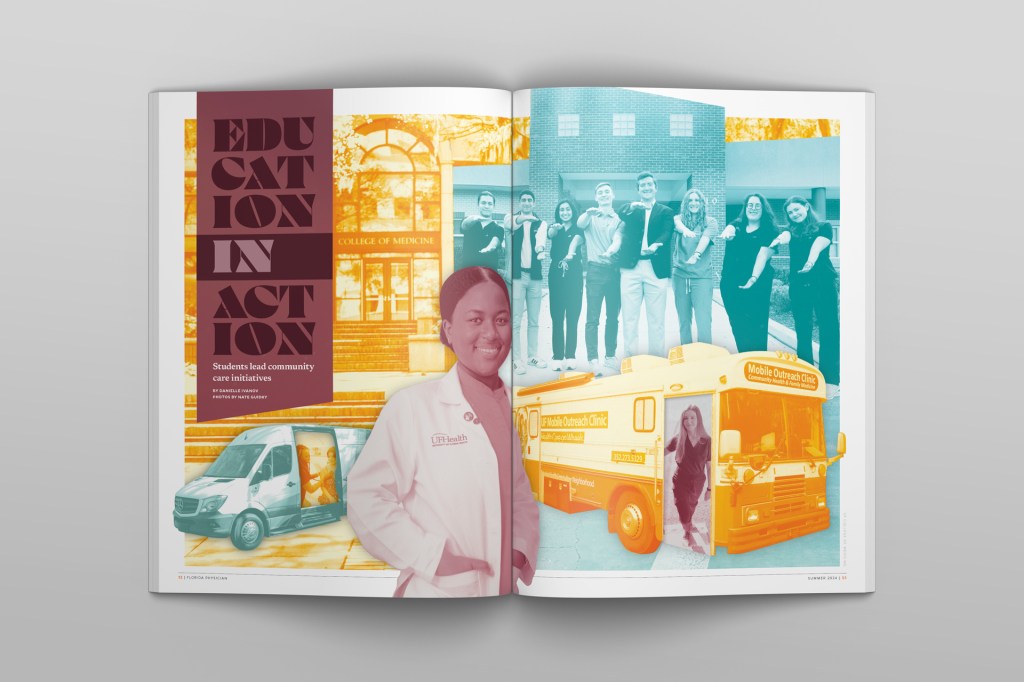
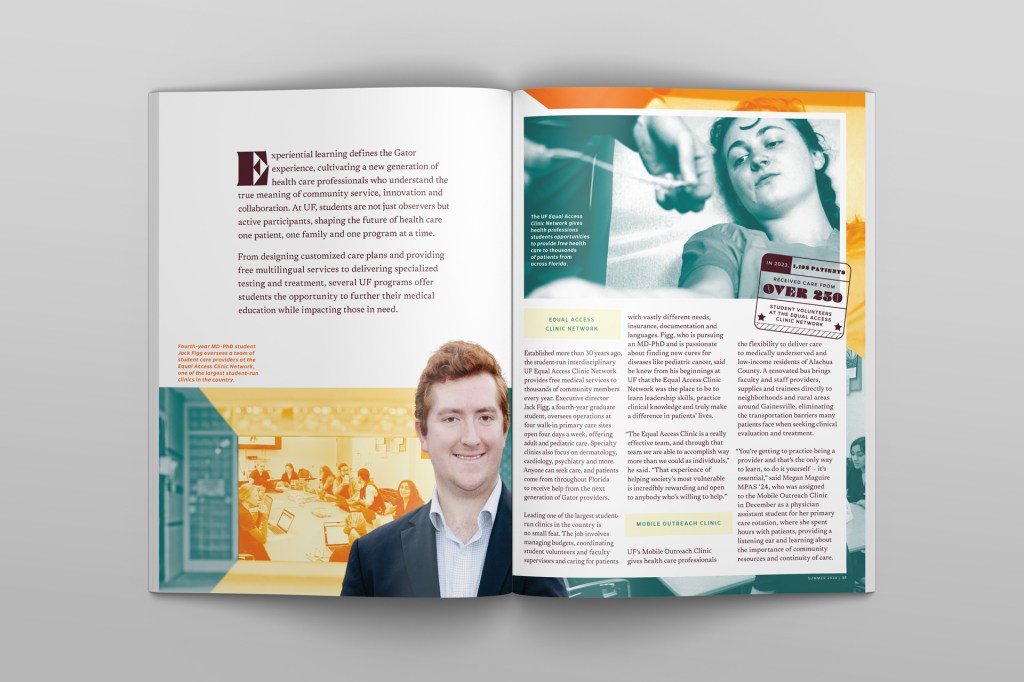
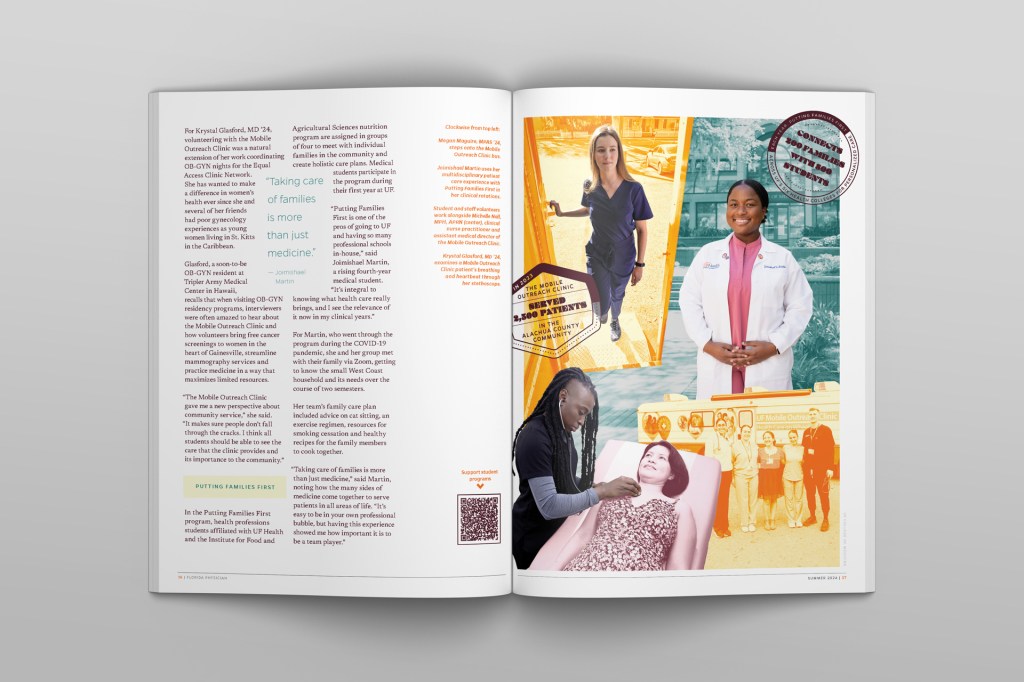
“Education in Action” is a story about three programs that allow students to lead community medicine initiatives. While directing the photoshoots for this story, I was struck by the incredible energy these students bring to community care.
I used saturated colors and a lively, irregular photo collage approach to bring that energy to the page. This also allowed me to combine scenes and include contexts to help the photography speak more clearly. The resulting spreads convey the idea that these myriad community medicine programs work together to create a foundation of service for our students’ medical educations.
Similarly striking to me was how important programs like these are to students’ education. Practicing medicine first-hand for patients who have traditionally found it hard to obtain medical care is a transformative experience for many of these young doctors. To reinforce this idea in design language, I included statistics designed to resemble passport stamps.
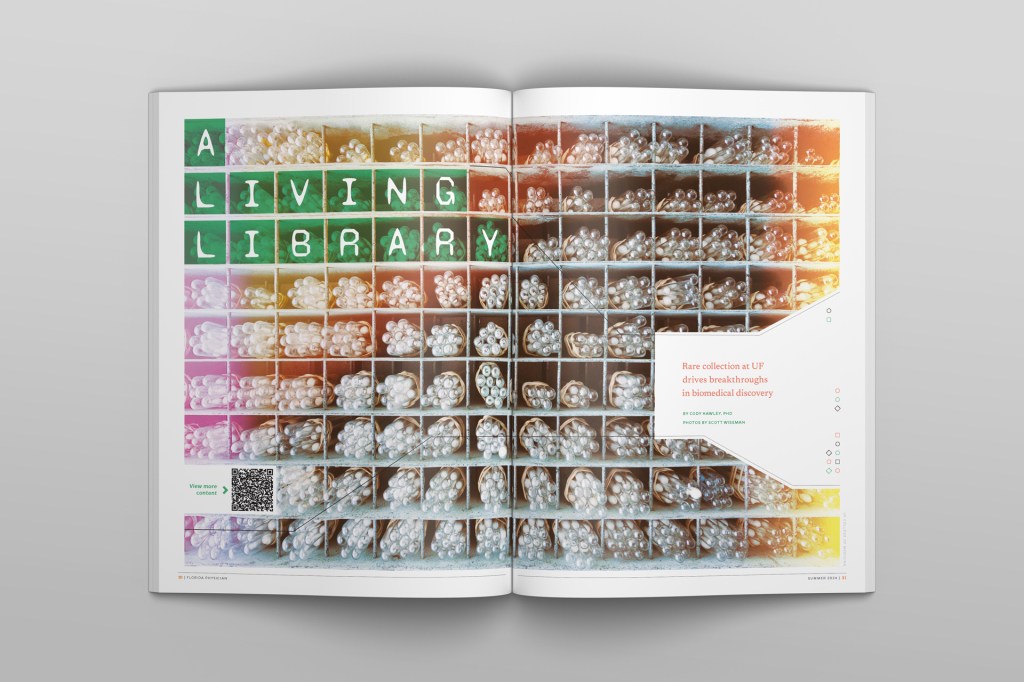
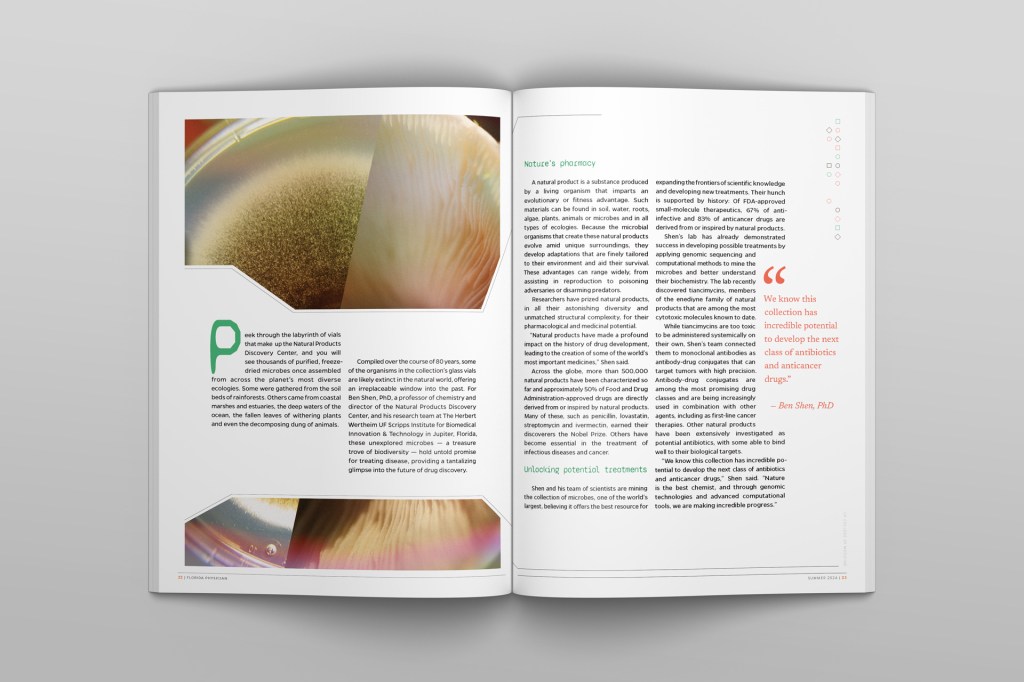
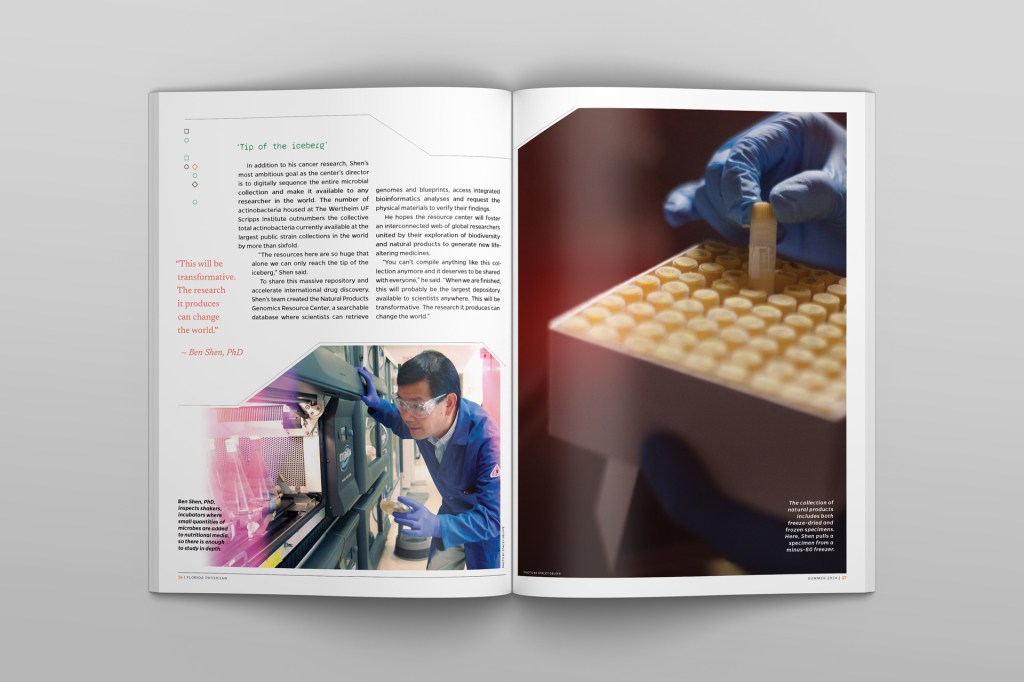
“A Living Library” is a piece about the unique and enormous natural products collection housed at UF Scripps. I was fascinated by the scale of the collection and by its purpose.
The collection is an archive of genetic material from natural products like plants, soil, bacteria, etc. Many of the products from which the DNA samples were extracted are now extinct or gone, but this archive can be used to resurrect them for the purposes of creating new medicines and therapies. To convey this, I used a series of funnel-shapes to constrain the article’s copy. This suggests how a species can go from abundance to near total depletion and then be resurrected for new purposes.
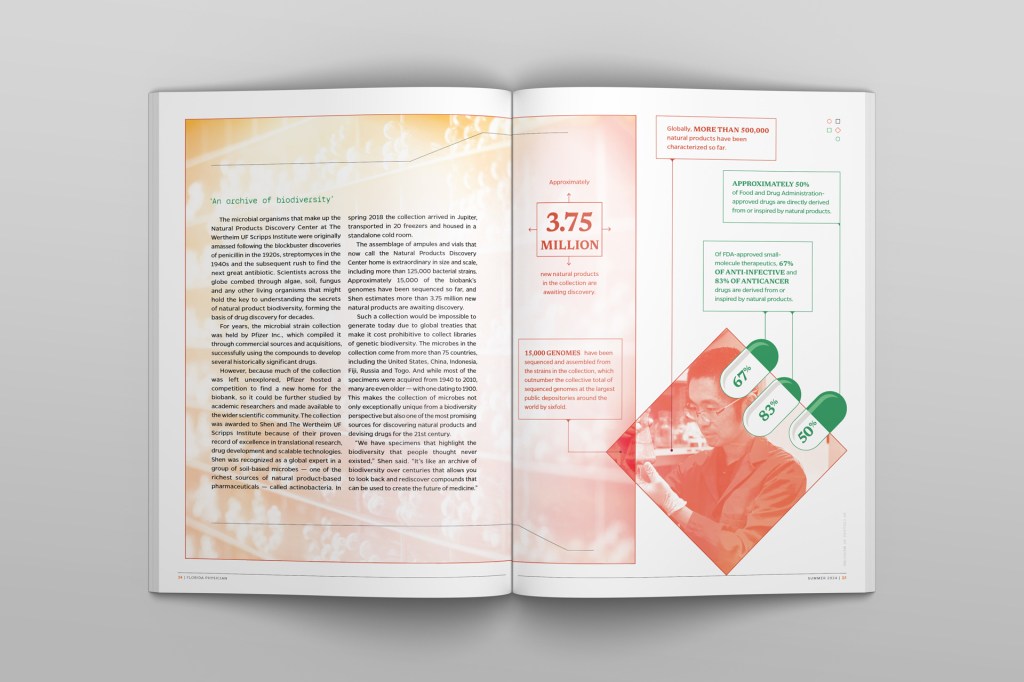
A secondary theme of the piece is the scale of the collection. Globally, around 500,000 natural products’ genomes have been sequenced thus far. The collection at UF Scripps accounts for 15,000 of those, with nearly 4 Million more samples awaiting characterization. I made an infographic out of the entire third spread of the piece to emphasize this. The box containing the copy represents the UF Scripps collection’s potential relative to the number of products already sequenced globally, and the overlap of the two shows just how much of the collection remains to be characterized. The green portions at the right illustrate the uses for natural products such as these, as well as the outsized proportion of medicines and cancer treatments that are created using natural product collections like the one at UF Scripps.
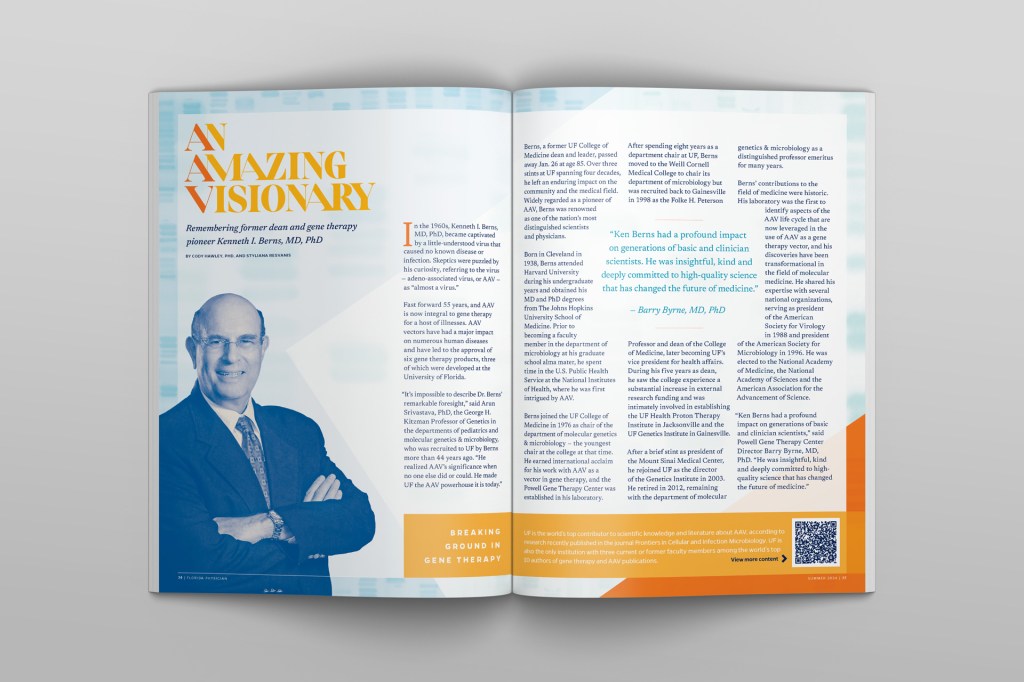
Dr. Kenneth Berns was a global pioneer in gene therapy and long serving leader at the UF College of Medicine.
His passing was felt by many current and former affiliates of the college, and we wanted to highlight his outsized contributions with a piece that celebrated him appropriately. We incorporated the acronym AAV (adeno-associated virus, a field of medicine he pioneered) into the title, used genetic sequencing patterns from a famous paper he wrote in the background, and leaned on the UF color palette to convey Dr. Berns’ importance to the college. His family was complimentary of the piece and received a poster version of it, making this a very special one for me.
 Michael McAleer