FP Fall 2023
“State of Mind” cover series
by Michelle Jaffee,
Danielle Ivanov,
Emily Mavrakis
and Matt Hesters
The Fall 2023 issue of Florida Physician magazine was my first as art director. The magazine was built upon a cover series exploring the many ways College of Medicine clinicians, researchers and faculty are making new discoveries in neuromedicine and neuroscience.
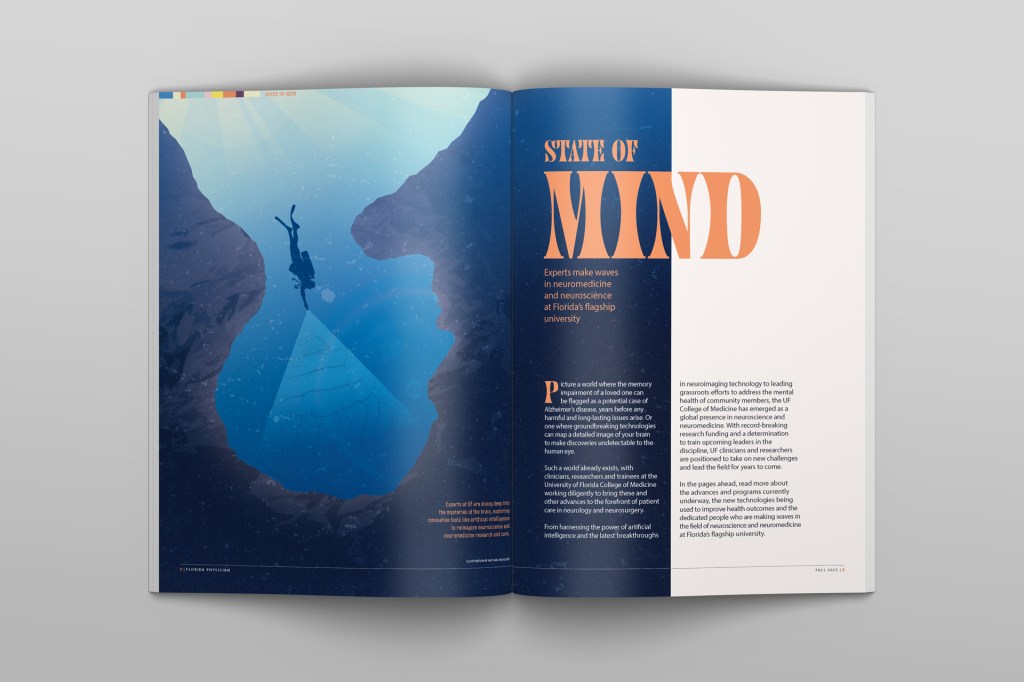
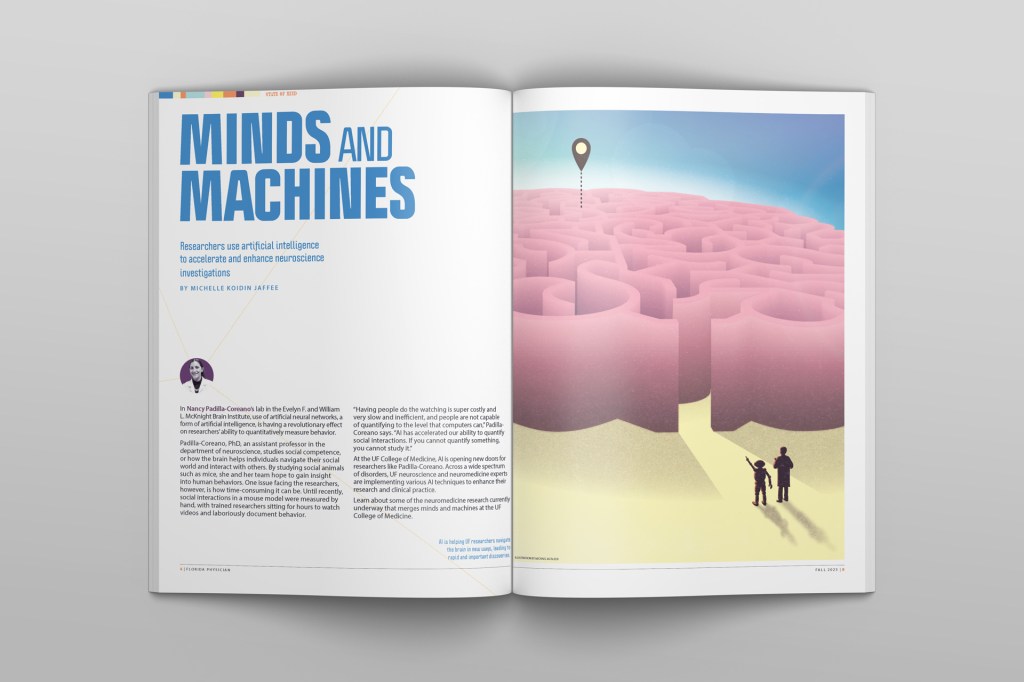
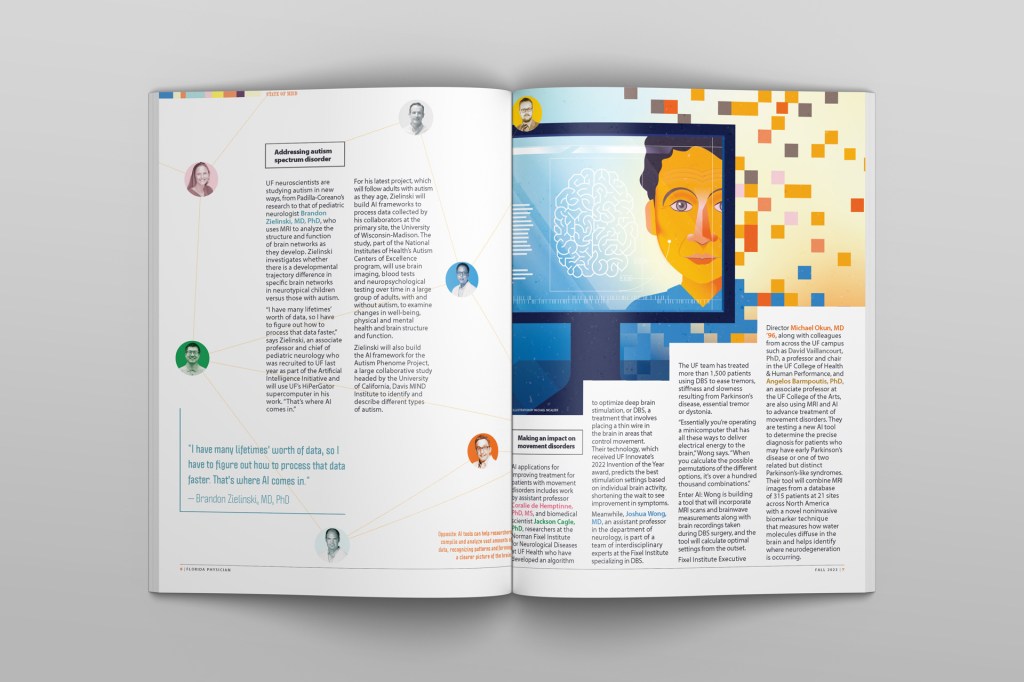
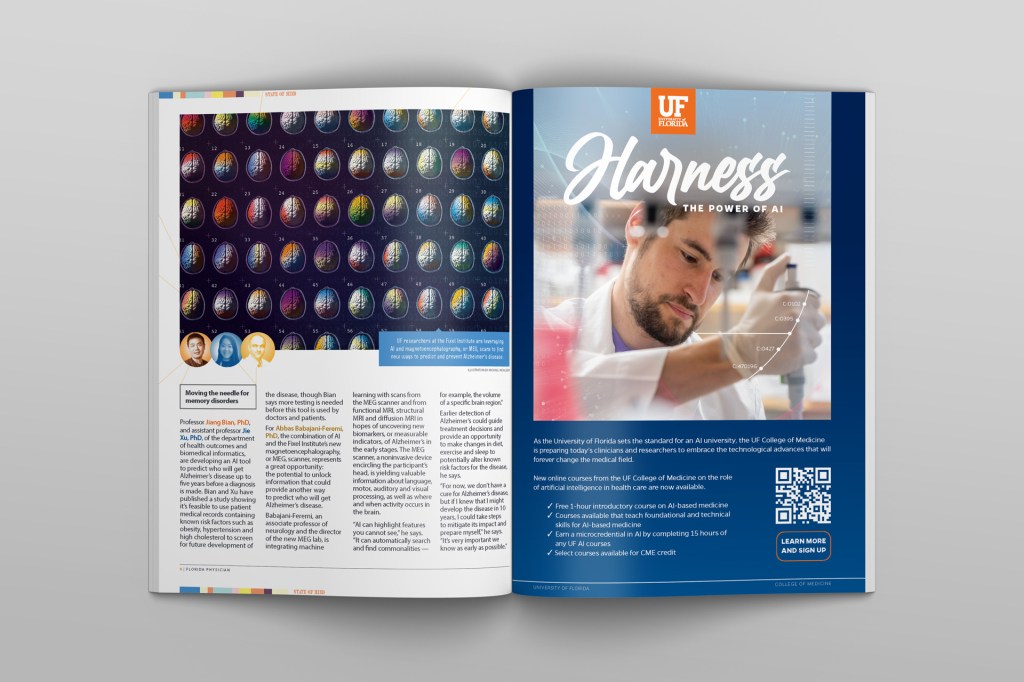
For the opening “Minds and Machines” piece, I created a series of editorial illustrations to illuminate the ways in which researchers and clinicians are using machine learning to improve our understanding of the human mind.
- The opening illustration (also used on the issue’s cover and animated to brilliant effect by Carlos Campos for social and web) depicts a doctor with a stethoscope diving into a cavern that resembles a human head. The cavern is dark, but the doctor’s dive light illuminates the mind inside. This reinforces the theme of novel exploration, as well as the common ways humans have always used tools to aid discovery and navigation.
- The second illustrates how researchers are using machine learning models to navigate the brain in new ways, leading to more efficient discoveries and more rapid treatments.
- The third depicts the ways machine learning tools can synthesize a clear image from vast amounts of disparate data. Researchers are using AI to form a better understanding of the mind than was previously possible.
- Researchers at the UF Fixel Institute are using AI tools to highlight commonalities among MEG scans that were previously invisible. In doing so, they’re finding novel ways to predict and prevent Alzheimer’s disease.
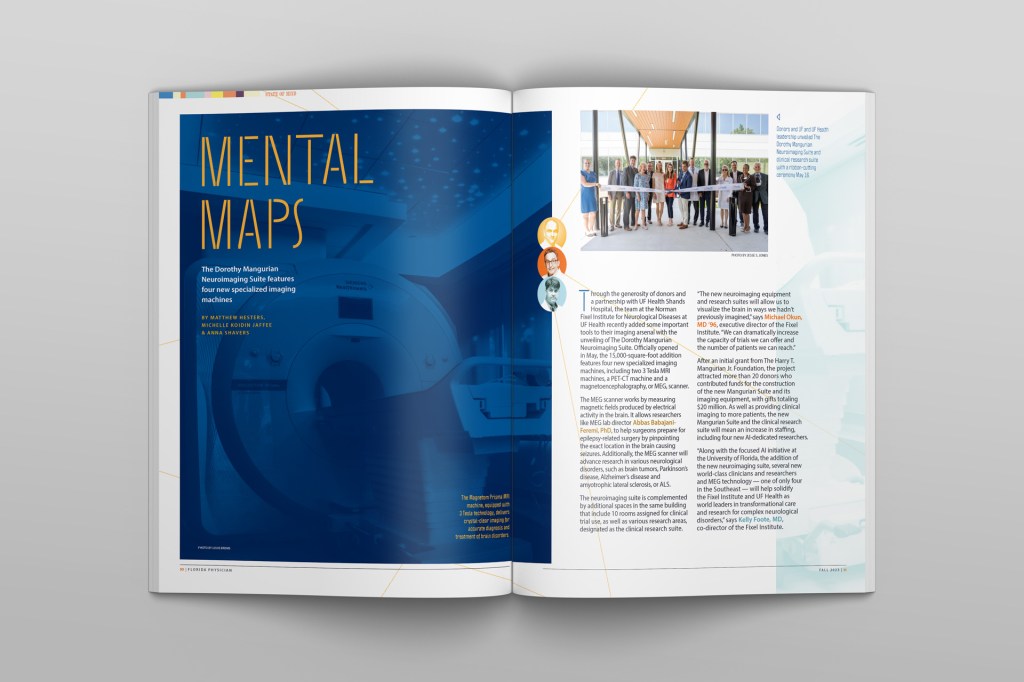
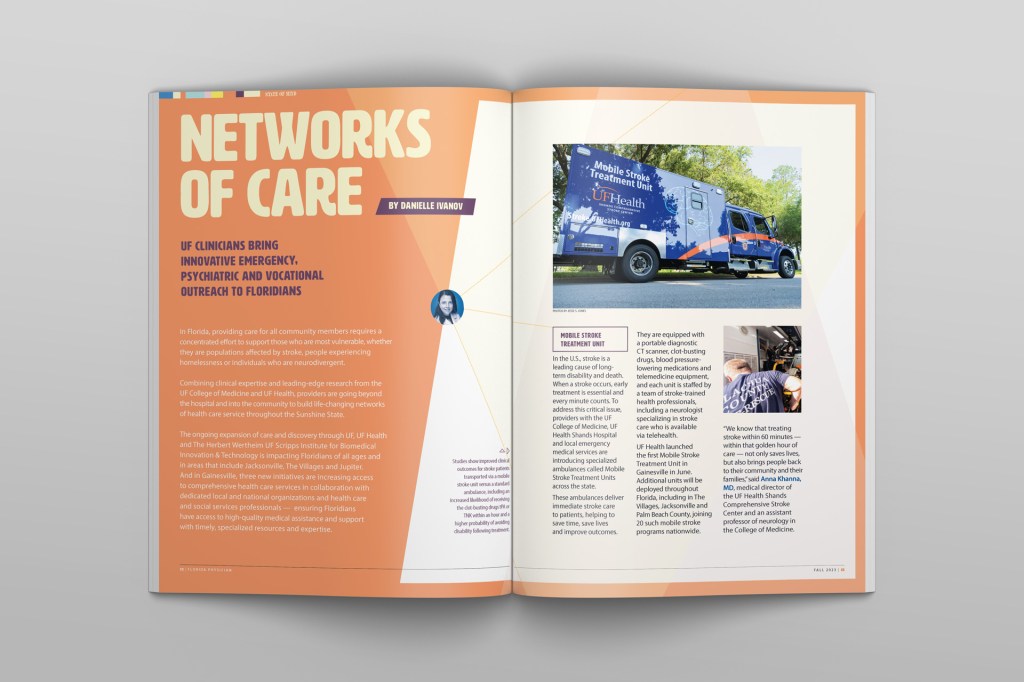
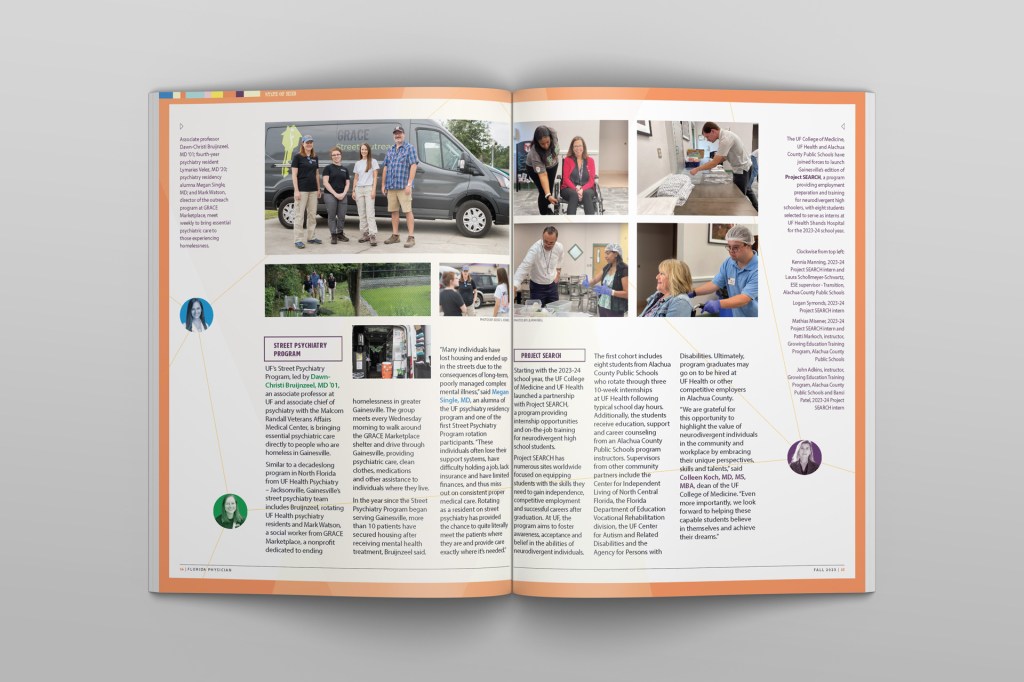
The second and third pieces in the series, “Metal Maps” and “Networks of Care” rely more on photography, which is better suited to supporting the copy here. Despite each piece recieving its own overall design, several visual elements carry over throughout the series for continuity.
I created a color palette for the series that is strictly adhered to throughout. There is a bar of these colors at the top margin of each spread in the series to add continuity. I also used consistent body and caption type styles throughout.
The names of the researchers and clinicians mentioned in each piece are highlighted in colors from the series’ color palette, and their portraits are included as nodes in a network that spans all of the series’ pages. This helps to illustrate how UF researchers are interconnected in their expertise, methods, and ultimately patient outcomes. The portraits are color graded to match the names in the stories, for readers’ reference.

